Tuesday, February 18, 2014

Formative Assessment That TRULY Informs Instruction

Sunday night, NCTE hosted a wonderful Twitter chat on formative assessment, led by Franki Sibberson and Antero Garcia, who were two members of the task force responsible for writing the position statement Formative Assessment That Truly Informs Instruction. You see, testing companies as of late seem to have sullied the term formative assessment and turned it into something much different than its original intent, which is to give teachers immediate feedback in order to adjust their teaching to help students make meaningful progress. That is where NCTE's new position statement comes in. There is a desperate need for schools to really consider how and what they are assessing their students. Therefore, this new position statement should be shared widely. It is a perfect vehicle for discussion, which was proved in spades, and 140 character bursts on Twitter this past weekend.

Here is a slideshow of some of my favorite tweets from the chat:

It is my hope that if you're a teacher, administrator, or educational policy-maker, you will not only take the time to read NCTE's position statement on formative assessment, but also share and discuss it among colleagues. Unlike the Common Core State Standards, this document gave teachers a seat at the table and contains a thorough annotated bibliography. Transparency, fairness, and professionalism in education -- what a concept!

Wednesday, February 5, 2014

Turning off my teacher voice

Since I left my teaching job in June of last year, I found that I immediately missed the classroom. This year of rest and rejuvenation has made me realize that it is darn near impossible to turn off my teacher voice, the one that looks for a teachable moment in almost every situation.

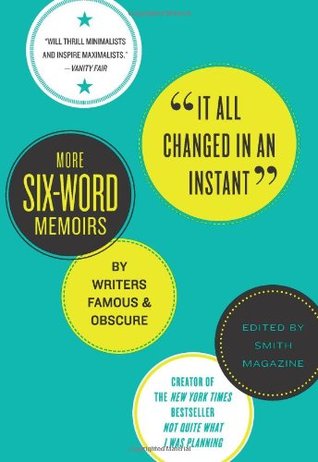
For example, I recently finished reading It All Changed in an Instant: More Six-Word Memoirs by Writers Famous and Obscure, and all I could think about were the ways six-word memoirs could be used as a form of assessment in almost any subject-area. In English class you could ask students to write six-word memoirs for the protagonist and antagonist in the books they finish. In social studies students could write a six-word memoir for a famous historical figure like Napoleon, Abraham Lincoln, or Nelson Mandela. In science students could write the six-word memoir of an amoeba or an element on the periodic table. There are so many ways this could be used that I get excited just thinking about it.

Another example of not being able to turn off my teacher brain was watching the Super Bowl on Sunday night. All those creative, funny, heartwarming, and profound commercials constantly keep me on the lookout for teachable moments. This year the commercial that immediately sent me into teacher mode was the Bob Dylan Chrysler commercial. Despite the fact that I really enjoyed it, I am also a bit dubious that Chrysler has been resting on their laurels and rather than innovating by trying something new (something, one would argue, that got them in that whole Bankruptcy mess) are trying to recreate the magic of Eminem's Imported from Detroit commercial from 2012. So I think it would be interesting to have students compare Chrysler's Super Bowl ads from the past three years and examine, not just the ads in their entirety, but also isolate the writing (I am an English teacher after all) to see their effectiveness on a strictly text-based level. Where are the similarities and how are they different? Just writing about this makes me wish I were in my own classroom this year.


I gotta admit, all three of those ads do make me wanna buy a Chrysler so while I am critical of their motives, I can't deny the ads stir the soul.

So the moral of the story is, no matter how hard I try (oh who am I kidding, I'm not really trying) I can never turn off my teacher voice.

Friday, January 24, 2014

Playing with Storify

Have you used Storify before? It's a great way to gather your favorite tweets of a particular theme and use them to tell a story.

Last Sunday I participated in #nctechat where the theme was digital learning and I wanted to play around with Storify's slideshow feature, so I favorited a few tweets from the chat and this is what I came up with:

Wednesday, December 11, 2013

Starbucks gift cards are nice but...

I was reading a Facebook post from author Gae Polisner this morning about an email of appreciation she sent to her son's teacher. She proceeded to talk about what that note meant to the teacher, and encouraged others to take a few moments to do the same for their own children's teachers. Her post got me thinking...

December is the time of year when teachers are showered with gifts from students and their parents. It can be overwhelming for us to receive so many Things. And it's not that we don't appreciate these generous, giving gestures from our students and their families -- we really do -- but before you head to Starbucks for that $10 gift card or head straight for that gift basket of body lotions, I want to share with you a simple truth: The gifts I treasured the most as a teacher were the words of thanks and the heartfelt notes of appreciation from both students and parents that made me feel like I was making a difference.


The families at my old school were so incredibly giving to the teachers at Christmastime and I don't want the purpose behind this blog post to make it sound like I'm being ungrateful. Trust me, my heart was full from being the receiver of such generosity. But after seven years of watching Christmases and end of school years come and go, here's what I'll remember being given the most:

  • The parent who sent me an email to thank me for turning her daughter into a reader
  • A thank you note from a mom at the end of the school year telling me that after putting three children through school, I was one of the best teachers her children had ever had 
  • A handmade card from a struggling student who talked about how being in my class helped him
  • The poem a student wrote me about our class that was so rife with growth and learning that it remains, to this day, the best gift a student ever gave me.

Still, every year, many teachers spend a large portion of their hard-earned money on their classrooms for the benefit of their students, so if you really want to buy them something, consider asking them what they need for their classroom. Whether it's much-needed office supplies or books for their classroom library, there's always something we could use for our students. But truly I say unto thee: if you really want to make a teacher's Christmas bright, a card filled with heartfelt, kind, encouraging words gets more mileage than a gift card ever could.
For a teacher, a handmade card filled with words of thanks and encouragement mean more than any material possession

Friday, November 29, 2013

The E in NCTE stands for Empowering, Energizing, and Enlightening


I've been avoiding writing about my NCTE experience for the past 2 days. I do that when I'm overwhelmed - avoid things. I've never been good at confrontation, what can I say. But in this case I'm overwhelmed in a good way. Overwhelmed by the learning, by the friendships I've formed, and by what an empowering experience it is to be part of the NCTE family.

The first year I attended NCTE was in Chicago in 2011 and I barely knew anyone then. Out of all the people I follow on Twitter I think I met three of them. I was still very shy and leery of putting myself out there.

But 2013 in Boston was a different story. Every corner I turned it seemed I was running into people I knew. Hugs were wielded out with enthusiasm and given to people I'd never met in real life (only on Twitter) because well, that's what you do when you're excited to be somewhere and surround yourself with like-minded people. You give hugs.

The excitement and hug-wielding all started on Thursday afternoon when I ran into a group of Nerdy Book Club friends and we had an impromptu lunch together - one of many impromptu meals I shared with friends in Boston.
Top: Colby Sharp, Me, Katherine Sokolowski, Donalyn Miller     Bottom: Donalyn Miller, Jen Vincent, Alyson Beecher, Paul Hankins

Later that evening in a last minute change to the program due to Tony Danza (who was originally the keynote speaker) being injured and in the hospital, Judy Blume stood in for him as an informal interview with her longtime editor Beverly Horowitz. Judy was planning on attending NCTE to receive the intellectual freedom award but she graciously agreed to stand in for Danza with virtually no notice. As always, she was a class act. A highlight of the convention for me was when I stood in line to get one of her books signed and she recognized me from Twitter since I had emailed her in September and asked her to be a part of our #nctechat for Banned Books Week.

On Friday the general session was something different than the typical keynote speaker, it was a hip-hop/spoken word poetry performance troupe from the University of Wisconsin - Madison known as First Wave.
First Wave - photo credit: Ernest Morrell

All I have to say is that I should have known better. I should have been prepared with tissues because spoken word poetry always affects me emotionally. And this performance was no different. It's a good thing they were performing in a darkened ballroom because I was a sniffling, teary mess. Especially during this moment (excuse any errors or omissions, I was sitting toward the back and a few words were hard to hear):

Mr. Garrison was his name.
Nicknamed me J Dub
like I wasn't just his student...

Said
Listen up J Dub
I see you got your Jay Z 
thing goin on
but when you step in my class
I wanna see Shawn Carter...

You skip out my class
means I've failed my lesson.
I'm not gonna call your dad.
I'm not gonna call your mom.
I'm gonna call
you.

You understand J Dub?

I'm gonna call YOU.

I will forever remember that performance as a highlight of my NCTE convention experience, not just of 2013, but of all my years attending (past, present, and future). Kudos to NCTE for thinking outside the keynote box.

After First Wave I had to get myself together and meet with the group I was presenting with at 12:30. This was my first year presenting at NCTE and I presented with Kellee Moye, Jen Vincent, and Audrey Vernick. Our topic was using picture books as mentor texts for middle school and high school students and I was amazed that our session was standing room only - and most people stayed to the very end of the session which contradicted a dream (more like a nightmare) I had that our session started off standing room only and by the time it was my turn to speak there were two people left in the room.
Excited and humbled that our session was a full house - people were standing along the sides and sitting on the floor
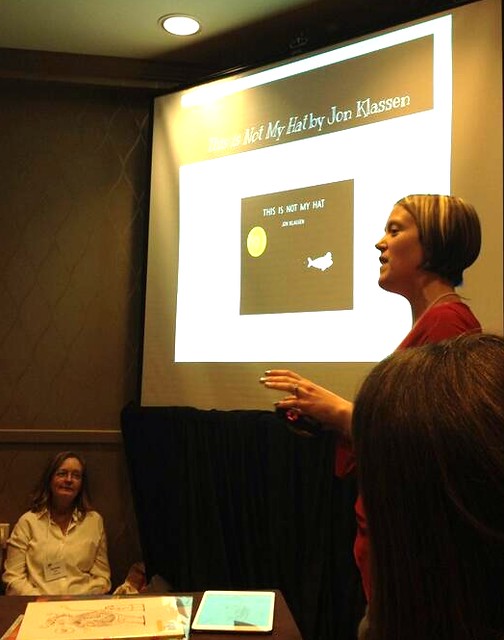
Me gushing over why Jon Klassen's THIS IS NOT MY HAT is perfect for high school students (photo credit: Jen Vincent)
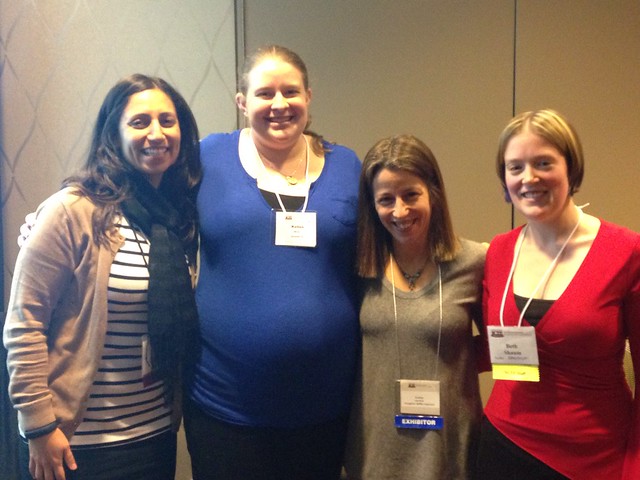
Jen Vincent, Kellee Moye, Audrey Vernick, and me
If you're interested, here is the link to my Slideshare of our presentation:
Rethinking Picture Books

After the session and all throughout the weekend I had so many people come up to me and say how much they enjoyed it. That made me feel so proud of our group and excited about the possibility of presenting again at NCTE, either on a similar topic or something completely different. Whatever the topic is, I've clearly got the bug.

Since this recap is getting ridiculously long, I will bullet point the rest of my NCTE 2013 highlights:

  • Hearing Temple Grandin speak for the first time, not only about the autistic brain, but also of her desire for legislators to stop making laws about issues they are too far removed from  - like, oh, I don't know, maybe education? She said she'd love for the show Undercover Boss to become Undercover Legislator. The room burst into applause when she said that.
  • Having lunch with my cousin Mariana whom I rarely get to see
  • Getting to hang out and share meals with my hotel-mates Cathy Blackler and Cindy Beggs.  Cathy's stories are downright hilarious. She needs to write a book, that's all there is to it.
  • Sharing a theater with enthusiastic English teachers and book lovers at the Scholastic screening of Catching Fire
  • Attending my first Ignite presentation and the wheels began turning as to how I could use this format in the classroom. 
  • Seeing #ncte13 trend on Twitter
  • Meeting Jack Gantos. He is one of the coolest people on the planet.
  • Laurie Halse Anderson and Chris Crutcher's keynote at the ALAN workshop. I wish book banners could be forced to sit in a room with these two inspiring authors. If Chris and Laurie can't change their minds then no one can. 
  • A.S. King's beautiful and compassionate speech as part of the Walden award panel at the  ALAN workshop
  • Discovering that Rainbow Rowell was on my flight home to Detroit and excitedly texting Sarah Andersen from 17 rows ahead of me before the flight took off. 

There are so many little moments from the convention that I could go on and on but it would take me days to write it all down. So  I will leave with this thought:

NCTE expected 6000 people to attend the convention in Boston but almost 7500 showed up. Many of those teachers pay their own way to come and be inspired by the great thinkers of their profession. Schools should be more willing to invest the time and money in their talent to allow their teachers to attend this convention (as Donalyn Miller says, professional development isn't an expense, it's an investment). But the fact that so many schools won't pay a teacher's way and STILL so many come on their own dime is a testament to the passion and dedication of these teachers.

Next year the NCTE convention will be in Washington DC. I really hope that the politicians responsible for making these "far removed decisions" as Temple Grandin would say, will come and listen to the concerns of REAL teachers. That they will look teachers in the eye and see a person, not a value-added score that determines whether they're effective or ineffective. Because anyone willing to pay their own way to a teaching convention and travel across the country on a teacher's salary is going above and beyond the call of duty and deserves to be heard - no matter what their value-added score says.


My #NCTE13 Storify (tweets I archived for myself)

Thursday, November 28, 2013

Reflection and Gratitude

Yesterday I went back to visit my old school. Every year they put on a pancake breakfast the day before Thanksgiving, so I thought it would be a good time to visit since I wouldn't be interrupting any important lessons. As I pulled into the driveway and saw the lights illuminating the windows of my old classroom, a small pang nagged at my heart. And despite the fact that I briefly met the teacher who now resides in my old classroom, I couldn't bring myself to go inside. She said to me, "Oh! You're Mrs. Shaum! The kids are always telling me I don't have enough books in here."

As I was going down the stairs from my old classroom, a couple of 8th graders were going up the stairs and one of them said to the other, "I think the other 8th graders are in Mrs. Shaum's room." I smiled at the student's blunder and said to her, "I'm glad to know it's still my room to you even though I'm not here anymore."

Catching up with old coworkers and talking books with former students made me realize even more how much I miss being in the classroom every day. But as much as I miss it, I also know that the path my life has currently taken is the right one. Seven years of an 84-mile-a-day commute is just too much. I do not regret my decision to leave my old school, but I am content and thankful for the people and experiences that led me to this moment to pause and reflect on the teacher I was and the one I am still becoming.

As I was leaving church with the 8th graders yesterday, one of them said to me, "Mrs. Shaum, the next time you come visit, you should bring some of that maple bacon ice cream you made. That was so good."

Bacon and books. It seems like that's what I'll be remembered for by my former students. I think I'll take it. :)

Wednesday, November 13, 2013

Book Review: Reading in the Wild by Donalyn Miller

Teaching is a career that can burn you out and drag you down. With so much political fervor in the education world today, not to mention faux research being purported as fact, it's hard to feel inspired anymore. That's where a book like Reading in the Wild stands out. Not only has Donalyn Miller done her research, but she has found a way for teachers and students to be inspired by learning again. And she doesn't just want it. She has found a way for you to do it in your own classrooms.

When I read The Book Whisperer almost four years ago, I felt inspired and empowered as a teacher. I knew the words I was reading about giving kids their reading lives back were important and just what educators needed to hear. I have never regretted a single day of completely changing the way I teach after reading Donalyn's first book.

But I, like Donalyn, initially lamented over the fact that once my students left my class, they stopped reading voraciously. Ever increasing homework demands coupled with lack of free reading time in their new classrooms left most former students barely reading five books a year, let alone the forty Donalyn invites her students to read under her tutelage. But Donalyn, being the ever reflective teacher that she is, recognized the need to pinpoint what behaviors lifelong readers possess and wanted to figure out a way to instill those behaviors in her students. How could she move her dependent readers to become independent readers. Thus Reading in the Wild was born.

I can't even begin to tell you what an important book this is. You just have to experience it for yourself. But I will say this: not only is Reading in the Wild inspiring, it is also practical. Donalyn shares her methods and her means of execution, sharing reproducible forms in the back of the book for you to use and implement in your reading workshop to help start you on the path to creating wild readers in your own classrooms.

If you teach reading in any capacity, please pick up this book. And when you're finished, give it to your administrators to borrow. The conversations about creating lifelong readers need to be happening among more people than just teachers. Administrators are the ones responsible for where the money goes and Donalyn has advice and recommendations for the people controlling the purse strings too.

It amazes me that when I first read The Book Whisperer, I didn't even know who Donalyn was, and now after following her on Twitter and meeting her at conferences, I can say that one of my teaching mentors has become a friend. That might make me biased about what an important book I think Reading in the Wild is, but I want to point out that it also shows how accessible Donalyn is to her readers and fellow teachers. I am grateful for The Book Whisperer and Reading in the Wild, but I am equally grateful for how available and amiable Donalyn is outside the pages of her books.

Follow Donalyn on Twitter: @donalynbooks

Review cross-posted to my book review blog A Foodie Bibliophile in Wanderlust

Reading in the Wild: The Book Whisperer's Keys to Cultivating Lifelong Reading Habits by Donalyn Miller
Published: November 4, 2013
Publisher: Jossey-Bass
Pages: 273
Genre: Nonfiction
Audience: Educators
Disclosure: Purchased copy