Yesterday was the fifth annual National Day on Writing but since it was on a Sunday, teachers around the country are celebrating today.
If you missed the fantastic #nctechat on Twitter last night, check out the Storify archive. It was an inspiring hour of discussion. You can also continue the conversation on Katherine Sokolowski's blog: Read, Write, Reflect.
The theme of this year's National Day on Writing is #write2connect.
There are many ways to interpret what it means to write to connect, but one that I seemed to latch onto stems from the following quote from E.M. Forester:
"How do I know what I think until I see what I say?"
Writing helps us understand and make sense of the jumble of thoughts running through our heads. So often students (and sometimes teachers) are of the opinion that they have to know what they think before they sit down and start writing. They haven't made the connection yet that writing is the vehicle to help us elucidate our thoughts.
When students use their writer's notebooks I want them to write without censoring themselves. I want them to feel free to explore and take risks and heed the advice of James Thurber:
"Don't get it right, just get it written."
But that's easier said than done isn't it? Often I find myself declaiming these platitudes in front of my students, but when it comes to doing it myself, I listen to the censor in my head more often than I care to admit. So in that way, I write to connect in order to empathize with my students. A writing teacher should be a writer. Just like a piano teacher should be a pianist.

Monday, October 21, 2013

Wednesday, October 16, 2013
Changing the Narrative: Finding What Teachers Are Doing Right
When I left my full time teaching job back in June to work part time for NCTE, one of the things I said I wanted to do this year was to visit classrooms and be inspired by the teaching profession again. Bogged down by my own exhaustion but more importantly, tired of the incessant public narrative that portrays teachers as incapable and incompetent to the point where we don't deserve any autonomy nor adequate compensation for the tireless work we do, I am setting out to change that dialogue.
So I decided I would perform my own little educational experiment: to visit the classrooms of friends and people I've met through social media and celebrate what they're doing right instead of contributing to toxic narrative the American public is being fed via politicians and the media.
Today I had one of those inspirational experiences I've been looking for.
My friend Kaitlin, whom I used to work with, is currently teaching a history class at the Mercy Education Project in Detroit for women who are working on getting their GED. The class I sat in on today was extremely small, only six women, but their passion for learning was monumental, as was their determination to make a better life for themselves and their families. I was honored and humbled to sit in on such a class.
Not only does Kaitlin teach these lovely women history, but she finds ways to tie in current events to what they're learning, she looks for resources to give voice and multiple perspectives to history, and I was even able to witness a beautiful moment at the end of class when one of Kaitlin's students said, "This makes me want to go out and vote."
To watch these women who have had what is likely a lifetime of disappointing educational experiences, be so involved and excited about their learning was so uplifting to see.
I was looking for inspiration and I found it. I hope I can keep this momentum going.
Thanks Kaitlin and to everyone at the Mercy Education Project for allowing me to come in and observe today and for being so welcoming. You all inspire me so -- mission accomplished!
So I decided I would perform my own little educational experiment: to visit the classrooms of friends and people I've met through social media and celebrate what they're doing right instead of contributing to toxic narrative the American public is being fed via politicians and the media.
Today I had one of those inspirational experiences I've been looking for.
My friend Kaitlin, whom I used to work with, is currently teaching a history class at the Mercy Education Project in Detroit for women who are working on getting their GED. The class I sat in on today was extremely small, only six women, but their passion for learning was monumental, as was their determination to make a better life for themselves and their families. I was honored and humbled to sit in on such a class.
Not only does Kaitlin teach these lovely women history, but she finds ways to tie in current events to what they're learning, she looks for resources to give voice and multiple perspectives to history, and I was even able to witness a beautiful moment at the end of class when one of Kaitlin's students said, "This makes me want to go out and vote."
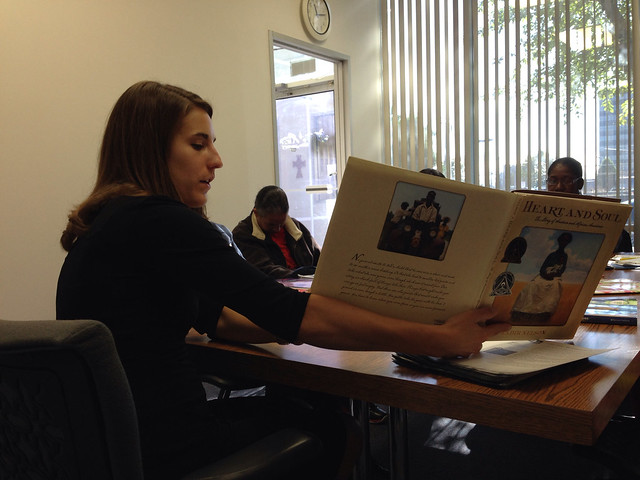 |
| Kaitlin reads from HEART AND SOUL by Kadir Nelson to give an African American perspective from the Revolutionary War |
To watch these women who have had what is likely a lifetime of disappointing educational experiences, be so involved and excited about their learning was so uplifting to see.
I was looking for inspiration and I found it. I hope I can keep this momentum going.
Thanks Kaitlin and to everyone at the Mercy Education Project for allowing me to come in and observe today and for being so welcoming. You all inspire me so -- mission accomplished!
Sunday, September 29, 2013
When anger and hurt feelings lead to dialogue
Something interesting happened today. I was perusing my Facebook feed when I came across this YouTube clip on Upworthy. Dr. Brene Brown went on the Oprah network and appears to be telling the world that pretty much every teacher in America shames/humiliates their students. And Oprah didn't challenge her. My initial reaction to this video was beyond offended. It was yet another example of how the public narrative of teacher bashing continues.
But them something extraordinary happened. Many teachers expressed their anger and frustration on Twitter, to which I will fully admit I instigated a great deal of the rancor, but then Brene Brown herself decided to engage in a civilized dialogue with all of us and clarified her meaning, which was not elaborated properly in that short video clip.
Did Brown use a really poor example in the above clip? Absolutely. (Because honestly, I know of absolutely no teacher who would ever call a child stupid). But her point about shame was not meant to single out teachers. Shame is pervasive in life -- even if we don't intend it. Perhaps I don't agree with everything she clarified and am still trying to process it all, but here's what I appreciate about today's turn of events: Brown chose to engage rather than ignore. Instead of discounting teacher frustration like so many "higher ups" in education do these days, Brown addressed them head on in a dignified, civilized manner. She didn't talk around the issue or give a camera-ready fake answer. She was real.
And while I'm satisfied with how this situation was resolved today, I am still frustrated. I'm frustrated because this is not how most educational dialogues go down. If people like Arne Duncan, Michelle Rhee, Bill Gates, and yes, Oprah, would address these criticisms head on and hear the concerns of REAL teachers, maybe some real good could happen in education. Instead, we have nothing but top-down reforms and legislation that prevent teachers from being able to teach because they're too busy doing test prep. And we also have TV networks doing entire "educational" summits with nary a classroom teacher to be found. So yes, I am pleased and grateful that Brene Brown was kind enough to engage with her critics in the trenches so to speak. I just wish more educational leaders would follow her lead.
But them something extraordinary happened. Many teachers expressed their anger and frustration on Twitter, to which I will fully admit I instigated a great deal of the rancor, but then Brene Brown herself decided to engage in a civilized dialogue with all of us and clarified her meaning, which was not elaborated properly in that short video clip.
Did Brown use a really poor example in the above clip? Absolutely. (Because honestly, I know of absolutely no teacher who would ever call a child stupid). But her point about shame was not meant to single out teachers. Shame is pervasive in life -- even if we don't intend it. Perhaps I don't agree with everything she clarified and am still trying to process it all, but here's what I appreciate about today's turn of events: Brown chose to engage rather than ignore. Instead of discounting teacher frustration like so many "higher ups" in education do these days, Brown addressed them head on in a dignified, civilized manner. She didn't talk around the issue or give a camera-ready fake answer. She was real.
And while I'm satisfied with how this situation was resolved today, I am still frustrated. I'm frustrated because this is not how most educational dialogues go down. If people like Arne Duncan, Michelle Rhee, Bill Gates, and yes, Oprah, would address these criticisms head on and hear the concerns of REAL teachers, maybe some real good could happen in education. Instead, we have nothing but top-down reforms and legislation that prevent teachers from being able to teach because they're too busy doing test prep. And we also have TV networks doing entire "educational" summits with nary a classroom teacher to be found. So yes, I am pleased and grateful that Brene Brown was kind enough to engage with her critics in the trenches so to speak. I just wish more educational leaders would follow her lead.
Friday, September 27, 2013
Dipping my toe back in the water
A new job fell into my lap this week. It's not instead of my NCTE job, but in addition to, as it is only two hours a week. I am helping with the writing lab portion of a college course designed for dual-enrolled high school students.
I started yesterday and even though I am a bit overwhelmed at being thrown into it, today seemed to go better. I'm still not entirely sure what my role is since I meet with the professor who's running the class on Tuesday. So I have been improvising. Today I gave the students a writing survey to gauge their attitudes towards writing and get a feel for their abilities. But my favorite part of the period came toward the end when I was talking to an exchange student in the class who is from Bulgaria. She had mentioned that she will have to repeat 11th grade when she goes back to Bulgaria next year and so I asked her what is the benefit of coming to the U.S. if you have to do an extra year of high school. Her answer was quite mature and very telling. She said, "I can't learn English in Bulgaria the way I can learn it here. Plus, life is all about experiences. I've traveled abroad before but no more than one or two weeks. Living in another country makes me appreciate different cultures but also my own culture."
She is much more mature at sixteen than I was at twenty-three. I didn't appreciate my experience living in Germany with my husband until I moved back home. Now I wish I could go back and have a do-over.
While we were talking, one of the boys in the class who has already proven to be a bit of a class clown came up next to me. At first I thought he had a question or was going to ask to go to the bathroom, but he continued to stand there as we were talking. I eventually turned to him and asked if he needed anything, but instead of asking to go to the bathroom he said that he thinks learning about other cultures is really interesting and he wants to to travel some day. The maturity and seriousness he revealed to me in that conversation made me remember why I love teaching in the first place: because kids will surprise you when you least expect it.
I started yesterday and even though I am a bit overwhelmed at being thrown into it, today seemed to go better. I'm still not entirely sure what my role is since I meet with the professor who's running the class on Tuesday. So I have been improvising. Today I gave the students a writing survey to gauge their attitudes towards writing and get a feel for their abilities. But my favorite part of the period came toward the end when I was talking to an exchange student in the class who is from Bulgaria. She had mentioned that she will have to repeat 11th grade when she goes back to Bulgaria next year and so I asked her what is the benefit of coming to the U.S. if you have to do an extra year of high school. Her answer was quite mature and very telling. She said, "I can't learn English in Bulgaria the way I can learn it here. Plus, life is all about experiences. I've traveled abroad before but no more than one or two weeks. Living in another country makes me appreciate different cultures but also my own culture."
She is much more mature at sixteen than I was at twenty-three. I didn't appreciate my experience living in Germany with my husband until I moved back home. Now I wish I could go back and have a do-over.
While we were talking, one of the boys in the class who has already proven to be a bit of a class clown came up next to me. At first I thought he had a question or was going to ask to go to the bathroom, but he continued to stand there as we were talking. I eventually turned to him and asked if he needed anything, but instead of asking to go to the bathroom he said that he thinks learning about other cultures is really interesting and he wants to to travel some day. The maturity and seriousness he revealed to me in that conversation made me remember why I love teaching in the first place: because kids will surprise you when you least expect it.
Wednesday, September 25, 2013
"I expect you to rise up as courageous people... and raise hell."
As I was perusing my Facebook feed this morning, I came across this blog post that Teri Lesesne shared:
A Time Comes When Silence is Betrayal by Michelle Newsum
What Newsum discusses in this blog post is how teachers have long been silent and absent in the political decision making. He quotes Jonathan Kozol from The Shame of the Nation at the end of his post:
“(This) is about the abolition of a national sin. So when people say, ‘What do you expect us to do?’ I say, ‘I expect you to rise up as courageous people have done before in America, and raise hell.’ I want to see our teachers develop a stronger political voice and find the courage to serve as witnesses to the injustices of which they are more keenly aware than anyone else... I do believe there will be another mass movement in this country, and I’d like to see it led by teachers.”
When I read a post like this I think about the fact that we're celebrating Banned Books Week this week and how teachers have long been encouraged to #SpeakLoudly against censorship (perhaps not within their own districts, but certainly nationally). That same attitude is not prevalent with education reform. Teachers are treated as a nuisance rather than an important part of the discussion, as recently evidenced by NBC's Education Nation panel that includes nary a teacher. Why are discussions about education always excluding the people who are doing the educating? Because the people leading the educational reform charge have corporate and financial interests to protect, certainly not the interests of the children. The people in the trenches, doing the hard work -- the TEACHERS -- have a message that just doesn't jive well with men in $1200 business suits looking to make a buck off our children's test scores.
But Newsum's blog post takes this idea a step further. She's telling teachers it's time to stop being silent. It's time to stand up for what you know is right. It's time to get in the game. It's time to use your outside voice.
"A time comes when silence is betrayal." - Martin Luther King, Jr.
A Time Comes When Silence is Betrayal by Michelle Newsum
What Newsum discusses in this blog post is how teachers have long been silent and absent in the political decision making. He quotes Jonathan Kozol from The Shame of the Nation at the end of his post:
“(This) is about the abolition of a national sin. So when people say, ‘What do you expect us to do?’ I say, ‘I expect you to rise up as courageous people have done before in America, and raise hell.’ I want to see our teachers develop a stronger political voice and find the courage to serve as witnesses to the injustices of which they are more keenly aware than anyone else... I do believe there will be another mass movement in this country, and I’d like to see it led by teachers.”
When I read a post like this I think about the fact that we're celebrating Banned Books Week this week and how teachers have long been encouraged to #SpeakLoudly against censorship (perhaps not within their own districts, but certainly nationally). That same attitude is not prevalent with education reform. Teachers are treated as a nuisance rather than an important part of the discussion, as recently evidenced by NBC's Education Nation panel that includes nary a teacher. Why are discussions about education always excluding the people who are doing the educating? Because the people leading the educational reform charge have corporate and financial interests to protect, certainly not the interests of the children. The people in the trenches, doing the hard work -- the TEACHERS -- have a message that just doesn't jive well with men in $1200 business suits looking to make a buck off our children's test scores.
But Newsum's blog post takes this idea a step further. She's telling teachers it's time to stop being silent. It's time to stand up for what you know is right. It's time to get in the game. It's time to use your outside voice.
"A time comes when silence is betrayal." - Martin Luther King, Jr.
Friday, September 20, 2013
Food for thought
I'm currently taking an English graduate course at Eastern Michigan University called "Issues in the Teaching of Writing." Our readings for this week include an English Journal article from July 2011 entitled "A Snapshot of Writing Instruction in Middle Schools and High Schools" by Arthur N. Applebee and Judith A. Langer. It's an interesting article about the amount of writing middle school and high school students do (or don't do) in their English classes and other subject areas.
I think the part of the article that stuck with me the most is a passage from the concluding paragraphs that states the following:
"...the actual writing that goes on in typical classrooms across the United States remains dominated by tasks in which the teacher does all the composing and students are left only to fill in missing information."
As I read that passage I thought to myself, "No wonder teachers are always so bogged down with work. We're spending way too much time composing for our students."
And then I wondered, how can we change this? There has to be a way that we can better challenge our students to think further and learn how to learn rather than learn how to fill in blanks while the teacher does all the hard thinking.
What do you think?
I think the part of the article that stuck with me the most is a passage from the concluding paragraphs that states the following:
"...the actual writing that goes on in typical classrooms across the United States remains dominated by tasks in which the teacher does all the composing and students are left only to fill in missing information."
As I read that passage I thought to myself, "No wonder teachers are always so bogged down with work. We're spending way too much time composing for our students."
And then I wondered, how can we change this? There has to be a way that we can better challenge our students to think further and learn how to learn rather than learn how to fill in blanks while the teacher does all the hard thinking.
What do you think?
Thursday, September 19, 2013
The purpose of art is washing the dust of daily life off our souls - Pablo Picasso
Last night I turned on my TV and happened upon The X Factor, a show I don't normally watch. I would have just changed the channel then and there but something compelled me to keep watching. A high school-age boy named Carols Guevara was auditioning. He has Tourette's Syndrome and has tried every medication possible but to no avail. The only thing that seems to work at calming his tics is music.
So there was this boy, up on stage talking to the judges, trying to control his tics and explaining about his condition, but as soon as the music came on and he started singing, he was a new person. The tics went away and he embraced the crowd with his lovely voice.
I sat there and went into the Ugly Cry. I mean, I was full-on sobbing. That moment for Carlos not only shows how important the arts are in our world, but especially in education. These are not frivolous endeavors that we should be adding to school curricula only if there happens to be some extra money lying around. In Carlos's case, music has enhanced his quality of life, and for so many kids the arts don't just enhance their lives, they are life-savers.
So there was this boy, up on stage talking to the judges, trying to control his tics and explaining about his condition, but as soon as the music came on and he started singing, he was a new person. The tics went away and he embraced the crowd with his lovely voice.
I sat there and went into the Ugly Cry. I mean, I was full-on sobbing. That moment for Carlos not only shows how important the arts are in our world, but especially in education. These are not frivolous endeavors that we should be adding to school curricula only if there happens to be some extra money lying around. In Carlos's case, music has enhanced his quality of life, and for so many kids the arts don't just enhance their lives, they are life-savers.
Subscribe to:
Posts (Atom)